Science Snacks: 👋 Hands & Wrists
SCIENCE SNACKS: Hands & Wrists
Our hands are how your nervous system speaks to the world.
Every gesture, grip, and graze is your brain in motion, translating thought into touch, intention into impact.
We talk with our hands because we’re wired that way—literally. The same brain regions that control speech also coordinate hand movement. It’s an ancient neural duet: gesture and voice evolving together to shape meaning, memory, and connection.
Hands amplify language. They help us think, learn, and be understood. They’re not just expressive—they’re expressive extensions of the mind.
Mini Anatomy Bites
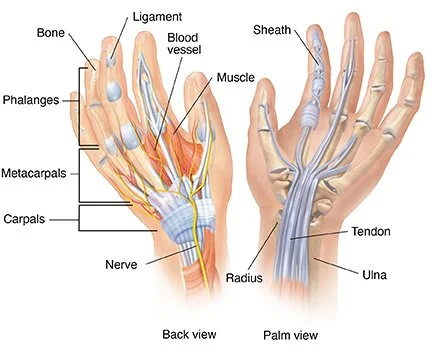
Bones
• Carpals → Stability base
• Metacarpals → Support bridge
• Phalanges → Fine control tips
Muscles & Tendons
• Intrinsics = Finger finesse
• Extrinsics = Power from forearm
• Flexors curl, extensors release
Nerves
• Median → Precision pinch
• Ulnar → Pinky-side strength
• Radial → Extension & sensation
🔍 Science Snack Tip: Use the “CLAP” mnemonic to remember key elements: Carpals, Lumbricals, Articulations, Palmar fascia
⬇️
• Carpals: These are the eight small bones that make up the wrist joint. Think of them as the keystone cluster that stabilizes and bridges movement between the forearm and the hand.
• Lumbricals: Slender, worm-like muscles inside your palm that don’t attach directly to bones (fun fact: rare in the body!). They help flex the fingers at the base and extend them at the tips—essential for delicate control like typing or tea-sipping pinky lifts.
• Articulations: This is the fancy term for joints. In the hand and wrist, it covers all the places where bones meet and move—like the radiocarpal joint (wrist) or the metacarpophalangeal joints (knuckles). Each articulation is a site of motion and nuance.
• Palmar Fascia: A thick sheet of connective tissue that fans out across your palm. It supports the arches of the hand, stabilizes the skin for gripping, and acts like a tension bridge between deeper structures and the surface layer.
💡 Metaphor Moment: The wrist is the light switch. The hand is the lamp. Nerves are your electric grid. One flick determines how brightly you shine—or if you short-circuit.
Movement Mechanics Snack
• Neutral wrist = Load-balanced
• Flexed = Strained & restricted
• Extended = Load-tolerant & responsive
• Claw grip = Intrinsic ignition
• Palm arch = Stability meets sensitivity
🌀 Mini Test: Tabletop finger spread → add a gentle weight shift → explore how your pressure shifts with micro-rotations.
Fascial Flavor
• Superficial Front Arm Line = Push power
• Deep Front Arm Line = Pencil grip finesse
• Spiral Line = Twist control
Prehab Snacks
• Wrist waves → Hydrate + mobilize
• Rubber band flicks → Extensor love
• Finger pushups → Low-load control
• Nerve glides → Pathway cleanup
🧠 Quick Bite: Hyperextension vs. Hypermobility
Hyperextension is when a joint moves beyond its normal range—like when the wrist bends past 90° in plank, creating compressive strain on ligaments and soft tissue. It’s often mistaken for “strong,” but it’s really just your joint hanging out without muscular support.
Hypermobility is a broader trait—more elastic ligaments and connective tissue allow extra range across multiple joints. In the wrist, this can look like effortless bends or deep backhands, but without strength and control, it becomes a sneaky setup for overuse or instability.
💡 Snackable Strategy: Swap “lock and lean” for “coil and engage.” A slight bend, active muscles, and fascial tension create a wrist that’s responsive—like a spring, not a slingshot.
🧩 Metaphor Moment: Hyperextension is like leaning on a rickety ladder—you might stay up, but at what cost? Stability, instead, is like gripping a climbing vine—you’re active, responsive, and ready to move.
✋ Key Alignment Principles:
1️⃣ 🏗️Wrist Stacking & Joint Centration
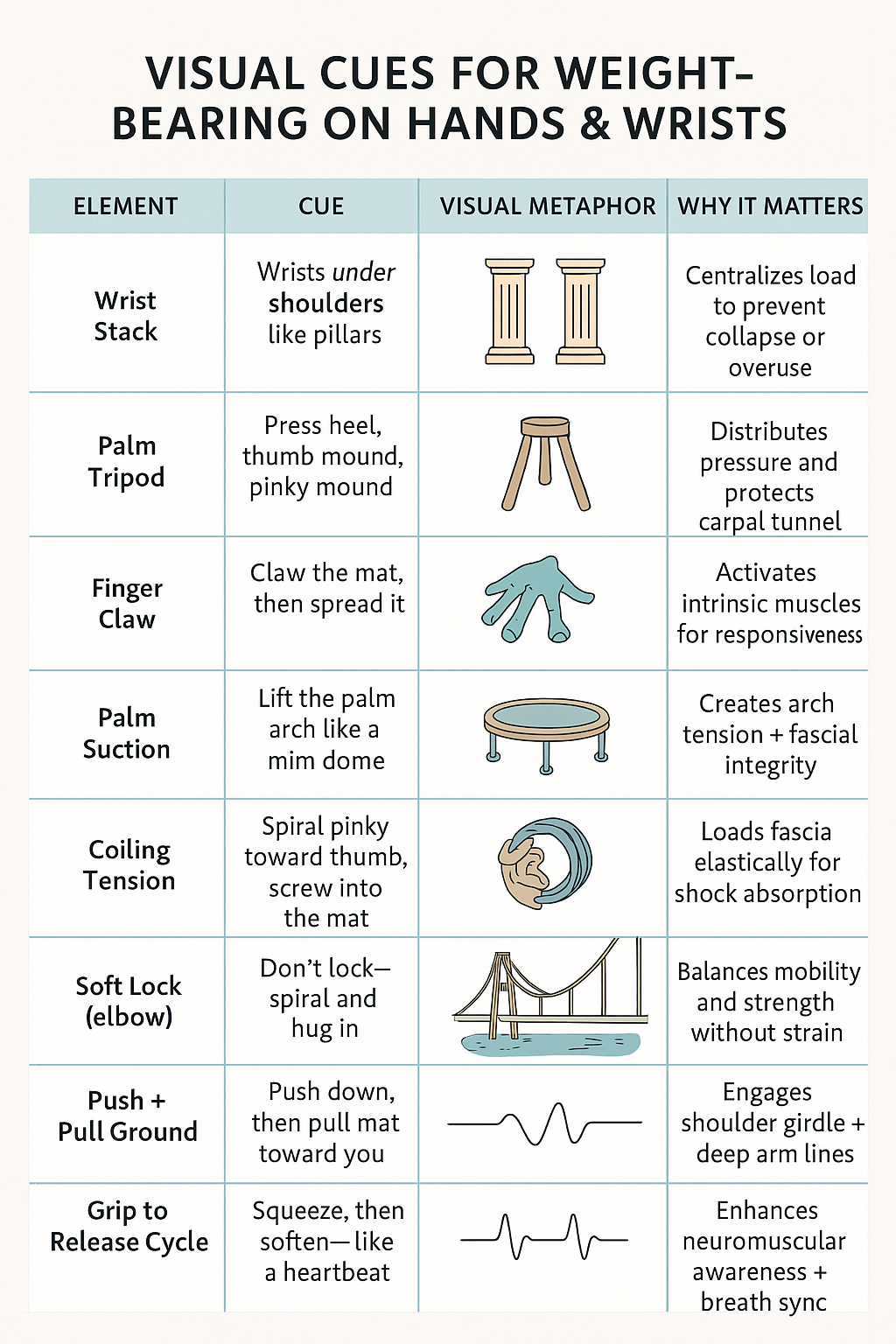
Stack wrists under shoulders like architectural columns. Avoid wrist collapse or palm “floating.” A well-aligned wrist becomes a transmitter, not a traffic jam.
2️⃣ 🪬Palm Tripod Activation
Distribute load through three contact points: heel of hand, base of index finger, base of pinky. This relieves pressure from the carpal tunnel and wakes up stabilizing fascia.
3️⃣ 💅Finger Intelligence
Subtle “clawing” engages the intrinsics—like shifting from a passive hand to a responsive, intelligent grip.
4️⃣ 🪢Coiling for Elastic Stability
Add a spiral: pinky toward thumb pad + external shoulder rotation = stored elastic tension. Think of it as “pre-loading a spring” before flight.
🔧 Build the Base: Prehab Before Push
To prepare for load-bearing, treat your wrists like your ankles—mobile, strong, and tuned to pressure.
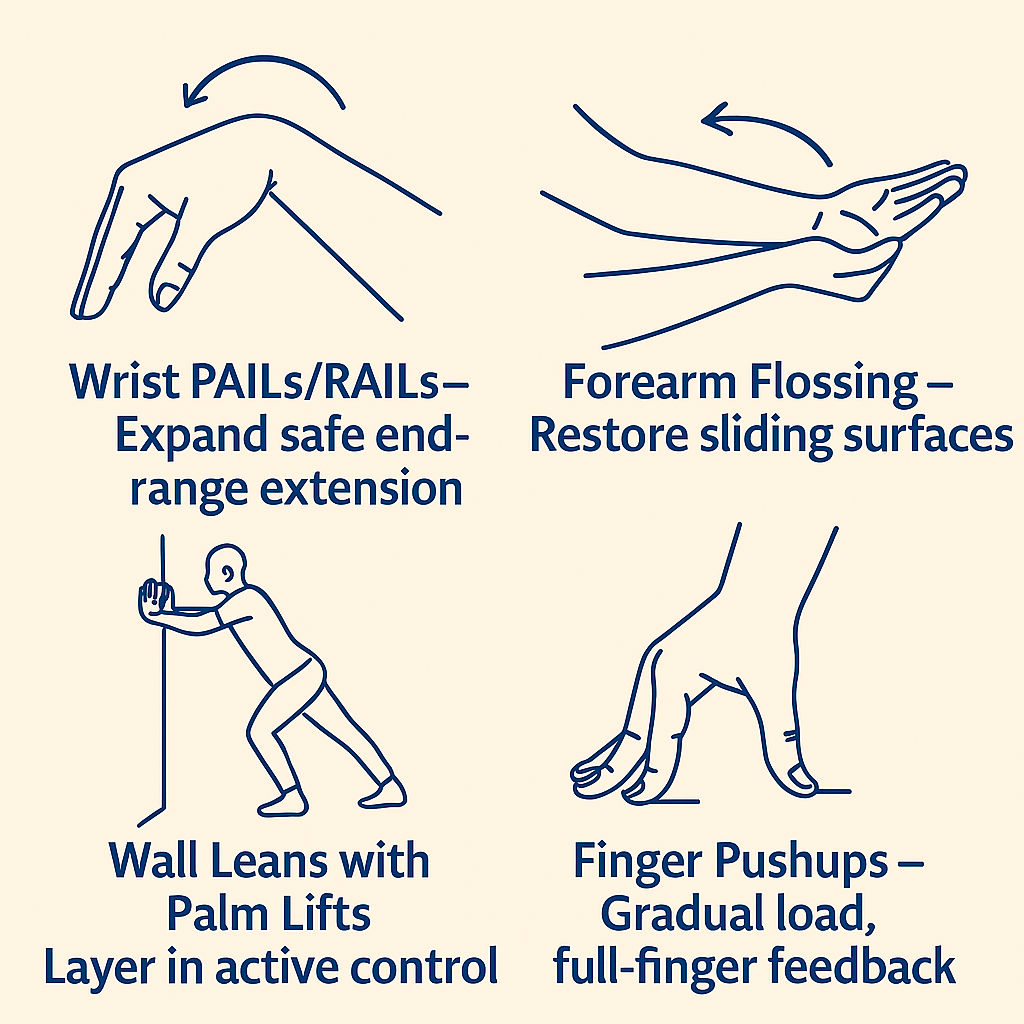
• Wrist PAILs/RAILs – Expand safe end-range extension
PAILs (Progressive Angular Isometric Loads) build strength at your current end range. RAILs (Regressive Angular Isometric Loads) help pull you deeper. Together, they make wrist extension more stable and resilient, not just more bendy.
• Forearm Flossing – Restore sliding surfaces
A gentle glide technique to mobilize nerves and fascia in the forearm. Think of it like un-kinking a garden hose—reduces tension and improves tissue glide without forcing stretch.
• Wall Leans with Palm Lifts – Layer in active control
Hands on a wall, lean forward, then lift the center of your palm while keeping fingers grounded. It trains fascia, coiling tension, and palm proprioception—like “foot tripod” for your hand.
• Finger Pushups – Gradual load, full-finger feedback
Start against a wall or on all fours—press through your fingertips to lift palms, then lower with control. Builds strength in the flexors, activates the intrinsics, and teaches load distribution in tiny doses.
Weight-Bearing Wonders: Hands & Wrists in Action
From plank to crow to handstand, your hands and wrists are the launch pads of upper-body loading. When aligned and activated, they don’t just carry weight—they channel force, communicate with fascia, and translate intention into grounded power.
❗ Watch for Red Flags:
• Hyperextension Hang-Outs: Looks straight, feels locked. Encourage a micro-bend and muscle engagement.
• Elbow Wander: In poses like Down Dog, notice if elbows spin or collapse in. Coiling cue: external upper arm + gentle forearm hug.
• Thumb Dominance: When the thumb hogs the press, the pinky and outer arch of the palm often disconnect.
🎯 Cue it Like a Coach:
• “Claw the mat, then spread it.”
• “Push, then pull the ground toward you.”
• “Suction the palm like a foot tripod.”
• “Coil, don’t lock.”
Handy Facts for Curious Minds
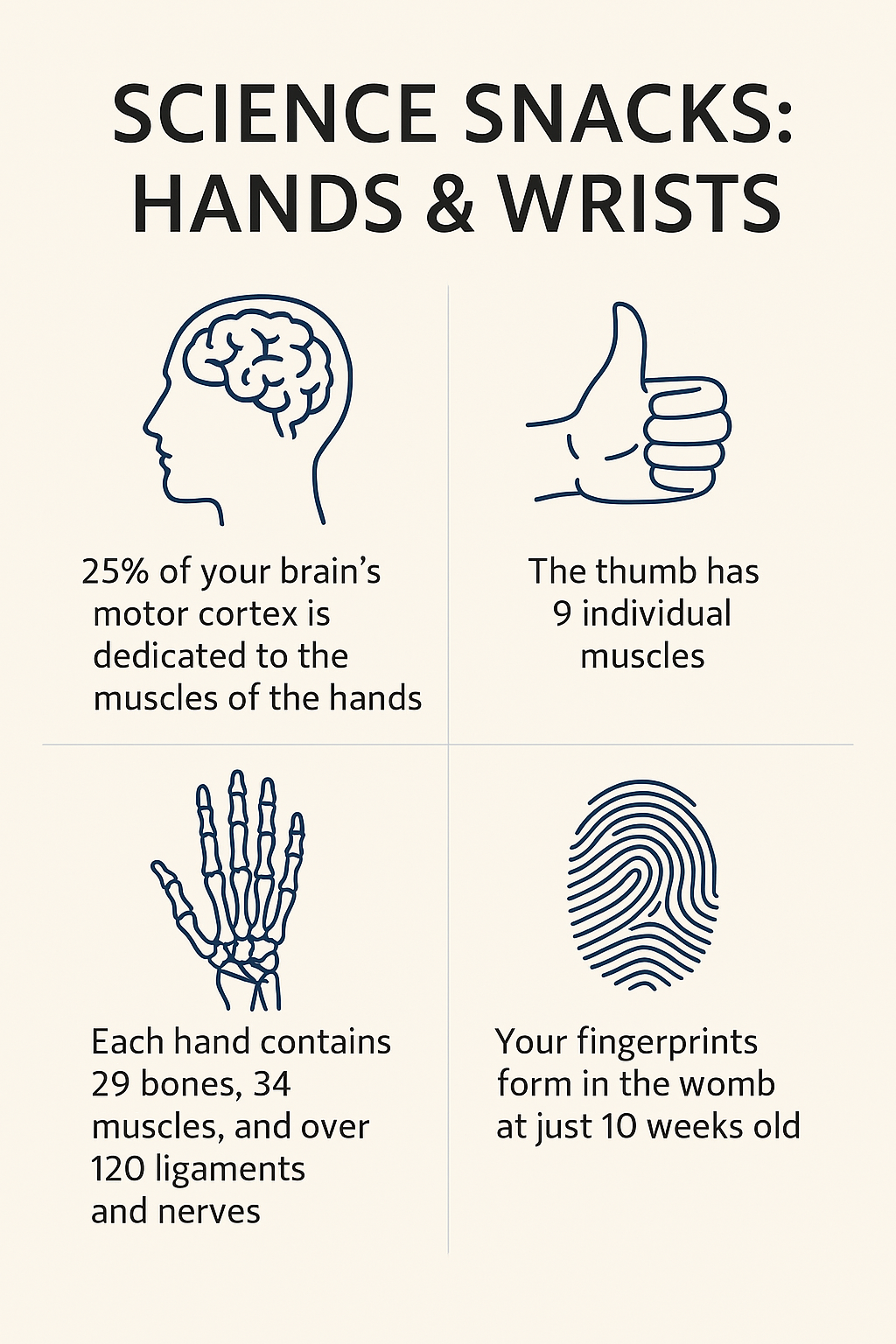
🖐 25% of your brain’s motor cortex is dedicated to the muscles of the hands. That’s a VIP suite of neural real estate.
🎨 The thumb has its own muscle entourage—nine individual muscles collaborate to make opposable thumb movements possible. Talk about teamwork.
🎻 Your fingers have no muscles—they move via tendons that pull from muscles in the forearm. Think “puppet strings” powered by your elbow zone.
🔁 Each hand contains 29 bones, 34 muscles, and over 120 ligaments and nerves. It’s a biological symphony packed into palm-sized architecture.
📎 The flexor digitorum profundus (yes, it sounds like a Harry Potter spell) is the only muscle that bends the last joint of each finger.
🔬 Your fingerprints form in the womb at just 10 weeks old—and no two are alike. Even identical twins roll with unique prints.
🧲 Grip strength is linked to overall health and longevity. It’s not just about handshake bragging rights—it’s a predictor of cardiovascular health.
🎯 The pinky contributes up to 50% of your grip strength. Underestimated, overdelivering—classic pinky move.
🐒 We share a lot of wrist anatomy with primates, but our fine motor precision (thanks to our flexor pulleys and thumb rotation) sets us apart in the evolutionary game.
🛠 Carpal means “wrist” in Latin, derived from carpus. Bonus: Karpos in Greek means “fruit,” which feels oddly poetic when you think of your hands as fruit-bearers of human effort.
Your hands are more than anatomy—they’re memory, meaning, and movement in action.
From delicate threads to dynamic holds, from gestures that connect to strength that grounds, hands and wrists are how we feel the world—and how the world feels us back.
Keep them curious. Keep them capable. Keep them talking.